Atmospheric drivers of basin-wide geostrophic transport in the Atlantic
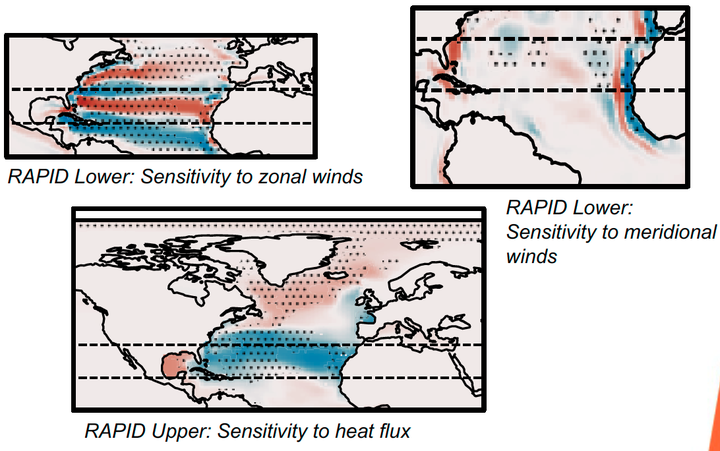 The rogues’ gallery of sensitivity patterns featured in the preprint
Abstract
The Atlantic Meridional Overturning Circulation (AMOC) is the overall effect of basin-wide meridional transport in the Atlantic, and is a central component of the climate system. Basin-wide geostrophic transport is frequently found to be a dominant component of observed and simulated AMOC variability and arises from across-basin pressure differences. Adjoint models have been used to quantify the sensitivities of the AMOC to past atmospheric forcing, however the sensitivities of the basin-wide geostrophic component are unquantified. We use an adjoint modelling framework to investigate the forcings and relevant timescales behind the interannual variability of the basin-wide geostrophic transport in the subtropical North and South Atlantic. We find that a combination of wind-driven and heat-driven variability, operating on a maximum timescale of 10 years, can explain 79-94% of the variability exhibited by the model. Wind-driven variability is mostly interannual and essential in all cases (64-88% explained variability). The heat-driven variability is largely decadal and only noticeable in the subtropical North Atlantic (48-52% explained variability). In the subtropical North Atlantic, western boundary pressures are more sensitive to atmospheric forcing events than the eastern boundary. We identify four spatial patterns of sensitivity that are relevant to our reconstructions. These include the sensitivity to: interior zonal wind stresses at local latitudes; along-slope winds at local and remote boundaries; interior heat fluxes at local latitudes; and interior heat fluxes at remote northern latitudes. We demonstrate how our sensitivity fields can inform perturbation-style experiments which quantify the significance of non-linear responses and diagnose the underlying physical processes.